Why Hot Air Balloons Are Basically Built to Break the Internet
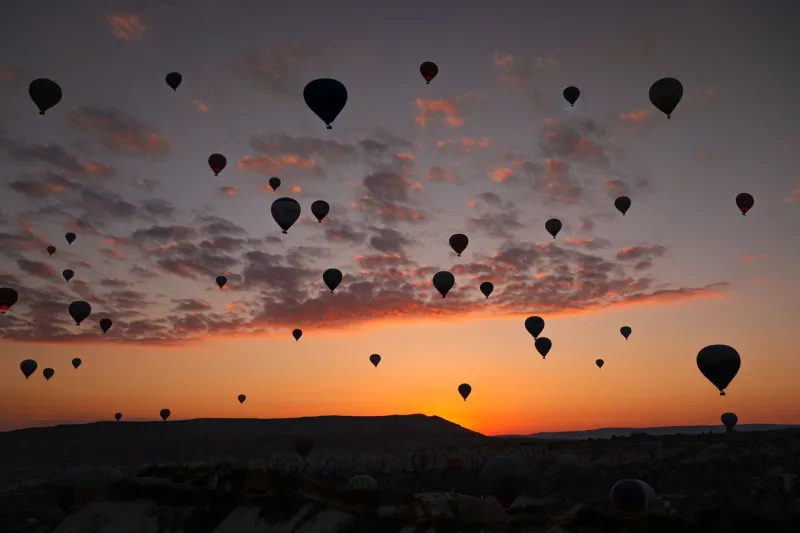
You've probably noticed it. You show up to a balloon festival with zero photography experience, point your phone at the sky, and somehow walk away with a shot that looks like it belongs on the cover of a travel magazine. Meanwhile, you've tried a hundred times to get a decent photo at a concert or a baseball game and ended up with nothing but blur and disappointment.
So what gives? Is it the balloons themselves? The setting? Some combination of good vibes and dumb luck?
Actually, it's science. Real, documented, fascinating science — and once you understand what's happening behind the scenes, you'll appreciate these moments even more (and yeah, you'll probably take even better photos).
Light Does Something Magical Near Balloons
Let's start with the most obvious visual ingredient: light. Hot air balloon festivals almost always launch at two specific windows — just after sunrise and in the hour or two before sunset. Pilots aren't doing this to be dramatic. They're chasing stable, low-wind atmospheric conditions that happen to coincide with what photographers call the golden hour.
During golden hour, sunlight travels through a much thicker slice of atmosphere than it does at midday. That extra atmospheric distance scatters shorter blue wavelengths and lets warm reds, oranges, and yellows dominate. The result is that everything — grass, faces, clouds, and especially the vibrant envelope fabric of a hot air balloon — gets bathed in a warm, diffused glow that's almost impossible to replicate artificially.
Here's where it gets interesting specifically for balloons: the nylon or ripstop polyester fabric used in balloon envelopes is semi-translucent. When sunlight hits it at a low angle during golden hour, the fabric doesn't just reflect that warm light — it transmits it. The balloon essentially becomes a giant, glowing lantern. Your camera sensor picks that up as this almost otherworldly luminescence that looks heavily edited even when it isn't.
Color Theory Is Doing the Heavy Lifting
Balloon festivals are one of the few places in the natural world where you'll find dozens of highly saturated, intentionally designed color combinations floating against a neutral sky. That's not an accident — it's a color theory goldmine.
Balloon manufacturers design envelopes to be visually striking from the ground, which means they lean hard into high-contrast color pairings: complementary colors like orange and blue, or yellow and violet, that sit opposite each other on the color wheel. When those combinations appear together against a pale blue or gradient sunrise sky, your brain processes them as exceptionally vivid. It's called simultaneous contrast — colors appear more intense when placed next to their complements.
Now multiply that by twenty or thirty balloons in the same frame. Your eye doesn't know where to look, which paradoxically makes the whole composition feel energetic and dynamic. Photos with that kind of controlled visual chaos tend to perform extremely well on social platforms because they hold attention longer than simpler images.
Your Brain Is Wired to Love This Shape
The sphere — or more accurately, the teardrop shape of an inflated balloon envelope — is one of the most universally appealing forms in visual perception. Research in gestalt psychology suggests that rounded, closed shapes feel stable and complete to the human eye. They're easy to process. They don't demand cognitive effort the way jagged or asymmetrical shapes do.
When you see a cluster of balloons rising into the sky, your brain gets a hit of what psychologists call fluency — the pleasurable ease of processing a visually harmonious scene. That feeling registers as beauty. It's the same reason bubbles, full moons, and ripe fruit photograph so well. The shape itself is doing emotional work before you've even consciously evaluated the image.
And when those rounded shapes are stacked at different heights against a gradient sky? You've accidentally created natural depth and layering — two compositional principles that photographers spend years trying to achieve deliberately.
The Ground Scene Creates Built-In Composition
Here's something most people don't think about: balloon festivals naturally generate foreground interest in a way that few outdoor events do. The inflation process alone — crews holding down envelopes, fans roaring, the slow rise of colorful fabric from flat ground to full sphere — creates a visual story arc that unfolds over about 20 to 30 minutes.
That means you're not just photographing a static object. You're capturing a process, and processes have narrative momentum. The leading lines created by tether ropes, the contrast between tiny human figures and enormous balloon envelopes, the crowd of spectators framing the launch field — these elements arrange themselves into textbook compositional structures (rule of thirds, leading lines, framing) without you having to think about it.
Festival organizers at events across the country, from the Albuquerque International Balloon Fiesta to smaller regional gatherings in the Midwest and Southeast, often lay out their launch fields in ways that are almost cinematically designed, even if that's not the primary intent. Open space, clear sightlines, and coordinated launches mean your frame is naturally uncluttered in a way that, say, a county fair midway never will be.
Atmosphere Adds the Final Layer
Early morning at a balloon festival often means dew, mist, or light ground fog — especially in valley locations that many festivals favor for their wind-sheltering geography. That atmospheric haze does something remarkable to photography: it creates aerial perspective.
Aerial perspective is the optical phenomenon where distant objects appear lighter and slightly bluer than close ones, giving an image a natural sense of depth and three-dimensionality. When a balloon rises through morning mist, the lower portion of the envelope might appear sharp and vivid while the top fades slightly into the haze. Your photo looks like it was shot with expensive glass and careful post-processing when really the atmosphere just cooperated.
Combine that with the golden light, the color theory, the gestalt-friendly shapes, and the built-in compositional elements — and you start to understand why balloon festival photography almost always outperforms whatever else you shot that weekend.
Use the Science, Don't Just Benefit From It
Knowing all this gives you a real edge. Instead of wandering the field and hoping something good happens, you can position yourself deliberately. Chase the backlit shots where the balloon fabric glows from within. Look for complementary color pairings in the lineup and frame them together. Get low to include human figures as scale references that emphasize just how enormous these things are.
Arrive early enough to catch the inflation sequence — that's your narrative arc unfolding in real time. And if there's morning fog, don't complain about the overcast conditions. That haze is your best friend.
The sky at a balloon festival isn't just a backdrop. It's a physics experiment, a color theory class, and a psychology lesson all happening simultaneously — and you've got a front-row seat. Might as well understand what you're looking at.