Shoot Like a Pro at Your Next Balloon Festival (Your Phone Is All You Need)
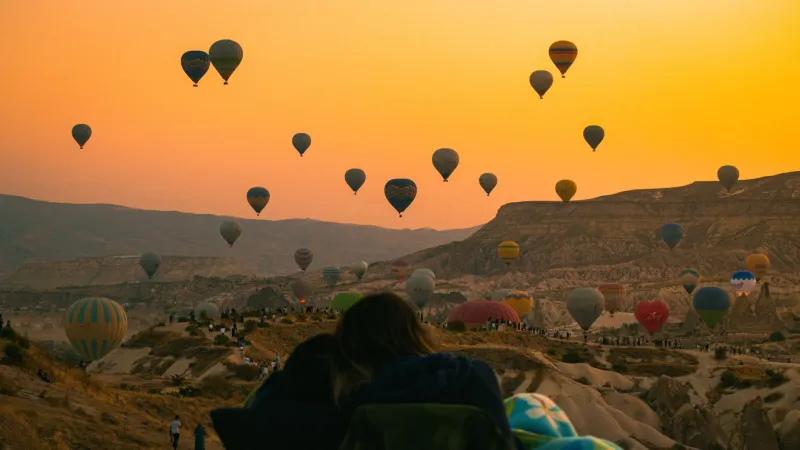
Every balloon festival has that one person — tripod, full camera rig, lens bag strapped across their chest — who looks like they're shooting for National Geographic. And then there's everyone else, phone in hand, wondering why their photos look flat compared to what they're actually seeing with their eyes.
Here's the thing: the gap between those two outcomes has almost nothing to do with equipment. It's about knowing when to shoot, where to stand, and how to work your phone's settings. Balloon festivals are honestly one of the most photogenic events you'll ever attend — the colors are insane, the scale is massive, and the light does things you just don't see anywhere else. You just have to know how to capture it.
Let's break it down.
Golden Hour Is Your Best Friend (Seriously, Set an Alarm)
If you only take one piece of advice from this entire article, let it be this: show up before sunrise. Most balloon festivals launch their morning flights right around dawn, and the light during that window is genuinely unreal. The sky shifts through deep purples and warm oranges, and when a balloon envelope catches that early glow, it looks like it's lit from the inside.
Sunset works too, but morning flights tend to have calmer winds, which means more balloons in the air at once and steadier conditions for you to actually compose a shot without rushing.
Practically speaking: check the festival schedule the night before, set your alarm 45 minutes before the first launch, and get to the field early enough to claim your positioning before the crowds settle in.
Lock Your Exposure — Don't Let Your Phone Guess
This is the single biggest technical mistake people make at balloon festivals. Your phone's camera is constantly trying to balance the exposure automatically, and when you've got a brilliantly lit balloon against a bright sky, it often gets it wrong — either the balloon looks washed out or the sky goes completely white.
Fix it by tapping and holding on the balloon in your camera app until you see the AE/AF lock indicator (this works on both iPhone and most Android devices). This locks both the focus and exposure to that subject, so the camera stops second-guessing itself.
For Android users, switching to Pro mode gives you even more control. Set your ISO between 50–100 in bright daylight to keep noise low, and adjust your shutter speed to keep the exposure balanced. If you're shooting during that early golden hour, bump the ISO slightly to 200 and let the warm tones do their thing — don't try to correct the color, that warmth is the whole point.
Think About Scale — Then Use It
One thing that makes balloon festival photos genuinely different from other event photography is the sheer size of the subjects. A fully inflated hot air balloon stands anywhere from five to nine stories tall. That's wild. But a lot of people's photos don't communicate that at all, because there's nothing in the frame to give the viewer a sense of reference.
Fix this by including people in your shots. A crowd watching a balloon inflate, a kid pointing upward, a couple silhouetted against an envelope — these elements anchor the scale and make the image feel alive rather than just decorative. Get low if you can. Shooting upward from ground level with a balloon filling the frame above a line of spectators creates a perspective that's both dramatic and instantly shareable.
Alternatively, step way back. Find a spot at the edge of the festival grounds and use your phone's zoom to compress a cluster of balloons against the horizon. This works especially well during a mass ascension when dozens of balloons are rising simultaneously.
Work the Glow: Night Glows Are a Different Game
If your festival includes a night glow — and a lot of the best regional festivals do — treat it as an entirely separate photography challenge. The rules flip almost completely.
During a night glow, balloons are tethered to the ground and their burners are fired in sync with music, creating these enormous, pulsing lanterns of color. The ambient light is low, which means your phone is going to try to compensate by increasing exposure time. That usually means blur.
To combat this: brace your phone against something solid — your partner's shoulder, a fence post, your own bent knee. Use the volume button or a Bluetooth shutter remote to trigger the shot without physically touching the screen, which reduces camera shake. On iPhone, Night Mode will activate automatically; let it do its thing but keep the phone as still as possible during the capture.
The best night glow shots are taken close. Get near enough that the balloon fills most of your frame, and time your shot for the moment the burner fires — that's when the colors are richest and the glow is most intense.
Composition Tricks That Actually Work in a Crowd
Balloon festivals are busy. Like, really busy. Getting a clean shot without strangers' heads and selfie sticks cluttering your frame takes a little strategy.
Go vertical for single balloons. Portrait orientation naturally suits the tall, narrow shape of a balloon in flight. It also performs better on Instagram and TikTok if that's where you're posting.
Use leading lines. Festival grounds often have natural lines you can work with — the rope tethers during inflation, rows of vendor tents, even the edge of a crowd. Position yourself so one of these lines draws the eye toward your main subject.
Shoot through something. A balloon partially framed by tree branches, a chain-link fence, or even another balloon in soft focus creates depth that flat, open-sky shots just don't have. It looks intentional and editorial, even if you stumbled into it.
Wait for the moment. The balloon that's mid-inflation — half crumpled on the ground, crew members holding the envelope open while the burner roars — is often more interesting than a fully inflated balloon floating serenely overhead. The process is part of the story.
One Last Thing Before You Go
Delete as you shoot. Seriously. Most people come home from festivals with 400 near-identical photos and no idea which ones are actually good. Give yourself a quick edit every 30 minutes or so — keep the best three from each sequence, trash the rest. You'll have a tighter, stronger collection by the end of the day, and you'll actually be able to find the good ones when it's time to post.
Balloon festivals are one of those experiences where the visuals genuinely match the hype. The sky really does come alive in ways that feel almost unreal. With a little intention behind the lens — or the screen, rather — you can bring that feeling home with you every single time.