Why a Field Full of Balloons Sticks With Your Kids Longer Than Any Theme Park Ever Will
Every parent has been there. You spent three grand on a week at a famous theme park, stood in lines that stretched past the horizon, and watched your kid ride the same spinning teacup four times in a row. Then, six months later, you ask them what they remember most about the trip. There's a pause. Maybe they mention the hotel pool.
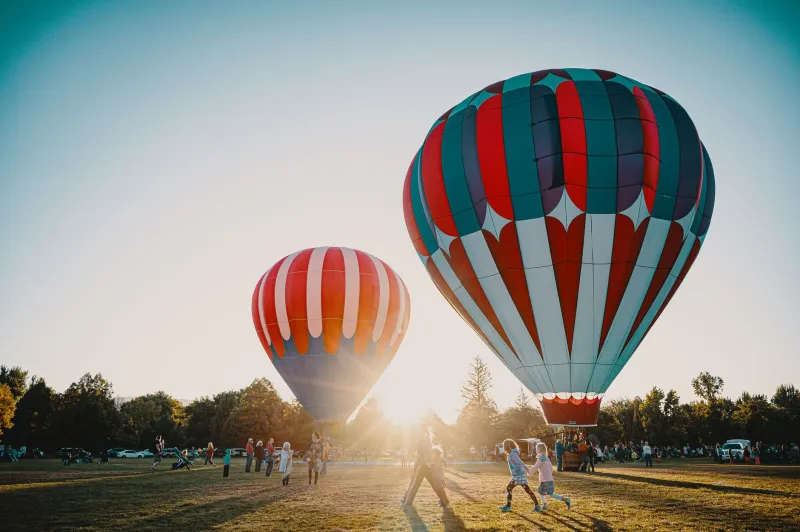
Now ask a kid who spent a single Saturday morning watching fifty hot air balloons lift off from a dew-covered field at dawn. Chances are, they'll describe the exact color of the balloon closest to them, the sound the burner made, the way the grass felt under their sneakers, and what their dad said when the first one cleared the tree line.
That gap isn't a coincidence. It's neuroscience.
How the Brain Decides What to Keep
Dr. Renata Holloway, a developmental psychologist based in Nashville, Tennessee, has spent more than a decade studying how children encode autobiographical memories — the personal stories we carry with us for life.
"The brain doesn't record experiences the way a camera does," she explains. "It selects. And what it selects for is novelty, emotional intensity, and multisensory input. When all three happen at once, you get what researchers call a 'flashbulb memory' — vivid, detailed, and remarkably durable."
Theme parks are engineered for excitement, but much of that excitement is delivered through screens, controlled environments, and repeated stimulation. The brain, particularly a child's developing brain, adapts quickly to predictable reward loops. The tenth time a ride launches you into a dark tunnel, the neurological response is already muted compared to the first.
Balloon festivals operate on entirely different terms.
Unpredictability Is the Secret Ingredient
Ask any veteran balloon pilot and they'll tell you the same thing: no two launches are ever alike. Wind shifts, weather windows, and the sheer logistical complexity of coordinating dozens of balloons mean that something unexpected almost always happens. A balloon drifts closer than anticipated. A crew scrambles to reposition. The whole field holds its breath as a pilot reads the sky.
For a child, that unpredictability is neurologically electric.
"Kids are wired to pay attention to things they can't fully predict," says Dr. Marcus Teel, a cognitive neuroscientist at the University of Colorado Boulder. "The prefrontal cortex is still developing well into the mid-twenties, which means children are especially sensitive to novel stimuli. An environment that keeps surprising them keeps their hippocampus — the memory center — highly engaged."
Disneyland is masterful at delivering a scripted version of wonder. Balloon festivals deliver the real thing, unscripted and a little bit wild.
The Sensory Dimension Nobody Talks About
Memory researchers have long understood that the more senses involved in an experience, the more robust the memory trace. It's why you can still recall the smell of your grandmother's kitchen but struggle to remember what you had for lunch on Tuesday.
Balloon festivals are a full-body sensory event in a way that's genuinely hard to replicate. There's the low roar of propane burners firing in the predawn quiet. The smell of damp grass and canvas and something faintly mechanical. The warmth radiating from an envelope inflating just a few feet away. The visual spectacle of color against a pale morning sky. The crowd noise shifting from murmur to collective gasp as the first balloon lifts free.
Jennifer Castillo, a mom from San Antonio, Texas, started taking her two kids to regional balloon festivals when her daughter was five and her son was seven. They're now teenagers, and she says the festivals remain some of the most talked-about memories in their family.
"My son still talks about the time a balloon landed unexpectedly in the field right next to where we were standing," she says. "The pilot let him help hold a rope during the pack-down. He was eight years old. He'll remember that when he's eighty."
Connection Over Consumption
There's another layer here that goes beyond brain chemistry. Theme parks, for all their engineering brilliance, are fundamentally transactional experiences. You buy a ticket, you consume an attraction, you move to the next one. The relationship between visitor and experience is largely passive.
Balloon festivals operate differently. The pilots are right there, often happy to talk to curious kids about how the envelope works or what it feels like to navigate by wind alone. Volunteer crews welcome questions. The whole event has a community-fair quality that invites participation rather than spectatorship.
Dr. Holloway points to this distinction as significant. "Children form stronger memories around experiences where they feel like active participants rather than passive observers. When a child interacts with a pilot or helps hold a tether line, they're not just watching something happen — they're part of the story. That's enormously powerful for memory encoding."
The Nature Factor
There's also growing research on what psychologists call "restorative environments" — natural settings that engage what's known as involuntary attention, the effortless, relaxed focus we experience when we're outdoors in open spaces. Studies suggest that memories formed in these environments tend to be both more positive and more detailed than those formed in artificial, high-stimulation settings.
A wide-open festival field at sunrise, with balloons rising against an early sky and the sounds of a waking morning all around, is almost a textbook restorative environment. The contrast with a climate-controlled theme park interior, blinking with screens and piped-in music, is stark.
"Nature-based experiences have a different quality of attention attached to them," says Dr. Teel. "Kids aren't overstimulated. They're genuinely present. And presence is the foundation of lasting memory."
Making It a Tradition
Families who've built balloon festivals into their annual calendar consistently report something interesting: each year's festival becomes richer because of the ones that came before. Kids start to develop a relationship with the experience over time — remembering what was different, what surprised them, what they're hoping to see again.
That layering of memory over memory creates what researchers call "autobiographical continuity" — a sense of personal history that's deeply tied to identity development in children.
The Castillo family now treats their annual balloon festival weekend as a non-negotiable on the calendar. "It's become part of who we are as a family," Jennifer says. "My kids plan for it. They talk about it afterward. It's not just an event — it's a thread that runs through our whole year."
You won't find that in a fast pass.
Getting Started
If you've never taken your family to a regional balloon festival, the barrier to entry is refreshingly low. Tickets are typically a fraction of what theme park admission runs, parking is usually straightforward, and the experience scales beautifully for every age — from toddlers who just want to stare at the colors to teenagers who'll quietly admit it's actually pretty cool.
Check our festival listings at srfballoonfestivals.com to find events near you. Arrive early, dress for the morning chill, and leave the agenda at home. The sky has its own plans, and that's exactly the point.