Three Hours That Outlast Any Ticket Price: The Science Behind Balloon Festival Memories
You've done the math on a theme park vacation. By the time you factor in park tickets, hotel nights, dining, and the inevitable gift shop meltdown, you're looking at $4,000 to $6,000 for a family of four. And yet, ask most adults what they actually remember from their childhood Disney trip, and you'll get something vague about a parade and a blister on their left heel.
Now ask someone who watched a dozen hot air balloons lift off over a misty valley on a Saturday morning when they were eight years old. Chances are, they'll describe it in color. The hiss of the burner. The way the balloon fabric glowed orange from the inside. The strange quiet of a crowd suddenly holding its breath together.
There's a reason for that difference—and it's not nostalgia. It's neuroscience.
What Makes a Memory Actually Stick
Memory researchers have spent decades trying to figure out why some experiences become permanent fixtures in our minds while others dissolve within weeks. The short answer comes down to a concept called emotional encoding. When an experience triggers a strong emotional response—awe, surprise, wonder, even a little healthy fear—the brain releases norepinephrine and dopamine, chemicals that essentially tell the hippocampus, "save this one."
Dr. Dacher Keltner at UC Berkeley, whose research focuses heavily on the emotion of awe, has found that awe-inducing experiences do something unusual to our sense of time and self. They slow perceived time down, make us feel smaller in a good way, and create what he calls a "vast, new" mental category—a moment our brain has no existing file for and therefore treats as exceptional.
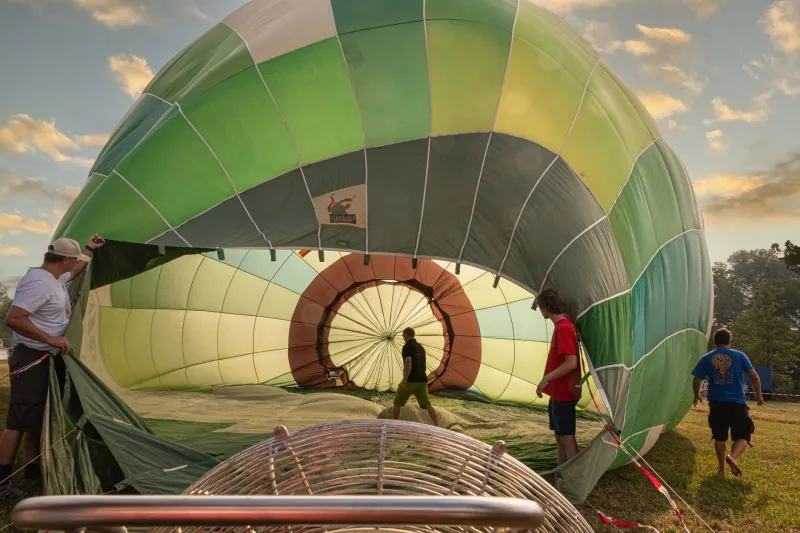
Hot air balloons, it turns out, are extraordinarily good at triggering awe. They're enormous in a way that defies expectation. They move in silence. They rise against gravity in a way that feels almost impossible even when you understand the physics. For a child whose frame of reference is still being built, watching a balloon inflate from a flat sheet of nylon into a five-story floating orb is genuinely mind-bending.
Theme parks, by contrast, are engineered for stimulation—but stimulation is not the same as awe. Roller coasters spike adrenaline. Bright lights and characters trigger excitement. But much of it is manufactured novelty, and the brain, particularly a child's brain, is remarkably good at adapting to manufactured environments. The "wow" wears off fast.
The Role of the Open Field
There's another element that balloon festivals offer which no theme park can replicate: unstructured time in a natural setting.
Decades of research on childhood development, including landmark studies from the American Academy of Pediatrics, consistently show that unstructured outdoor time is one of the most powerful contributors to cognitive flexibility, creativity, and long-term well-being. Kids who have room to wander, observe, and engage on their own terms—rather than being funneled through a scripted experience—form richer memories and develop stronger problem-solving instincts.
At a balloon festival, there's no FastPass line. There's no predetermined route. A kid might spend twenty minutes watching a crew spread out an envelope on the grass. They might wander over to a vendor and ask questions nobody told them to ask. They might just lie in the field and watch the sky fill up. That freedom is developmentally valuable in ways that a choreographed theme park experience simply isn't designed to be.
Sarah T., a mom from Tulsa who brought her kids to the Tulsa Balloon Festival for the first time three years ago, put it plainly: "My daughter spent forty-five minutes just talking to a pilot about wind patterns. Nobody organized that. It just happened. She still talks about it. She's in a science elective now and I honestly think that conversation had something to do with it."
Shared Experience and the Community Factor
Here's something theme park designers genuinely struggle with: you can be surrounded by thousands of people at a major attraction and still feel completely alone in your own private queue.
Balloon festivals are structurally communal. Everyone is looking at the same sky. Everyone gasps at the same moment when a balloon narrowly clears a tree line. The collective experience creates what psychologists call social bonding through shared attention—a phenomenon where strangers temporarily become a kind of informal group, united by a common focal point.
For kids, this is significant. Watching their parents laugh with people they've never met, seeing a crowd cheer together for no competitive reason, experiencing joy that isn't mediated by a screen or a ride operator—these are formative social lessons. They learn, almost by osmosis, that delight can be shared and that strangers can be trusted, at least for a morning.
Marcus R., a dad from Nashville who started taking his sons to regional balloon festivals in Tennessee and Kentucky, described it this way: "My older boy is pretty introverted. But at these festivals, he opens up. He'll start conversations with pilots, with other kids, with whoever. I think it's because the environment isn't competitive. Nobody's trying to get somewhere faster than anyone else."
The Novelty Window and Why It Matters
Child psychologists often talk about the "novelty window"—a period in early childhood when the brain is actively seeking new categories of experience to build its model of the world. Experiences that fall outside a child's existing framework don't just entertain; they expand the architecture of how that child thinks.
Hot air balloons occupy a genuinely unusual cognitive space. They're not cars. They're not planes. They move with the wind rather than against it. They require cooperation between a crew and the atmosphere itself. For a child trying to make sense of how the world works, a balloon festival is a masterclass in physics, teamwork, weather, and patience—none of it delivered through a worksheet.
This is part of why families who make balloon festivals a regular tradition often report that their kids develop an unusually strong interest in aviation, meteorology, or outdoor science. The experience plants a seed that structured curriculum rarely can.
What You're Actually Buying
Let's be honest about the comparison for a second. A family of four can attend most regional balloon festivals in the US for somewhere between free and $60 in gate admission. Add food, a souvenir or two, and a modest nearby hotel stay, and you're probably looking at $300 to $500 for a weekend.
For that, you get open sky, genuine wonder, unhurried time, and the kind of memory that doesn't require a photo to keep alive.
The $5,000 theme park vacation has its place. Nobody's saying skip it forever. But if you're weighing options for what to do with a free weekend in September, and there's a balloon festival within two hours of your house—and there probably is—it's worth asking what your kids will actually remember five years from now.
Our bet? It's the morning the sky filled up with color, and nobody told them where to stand.
Check our festival listings to find a balloon event near you this season.